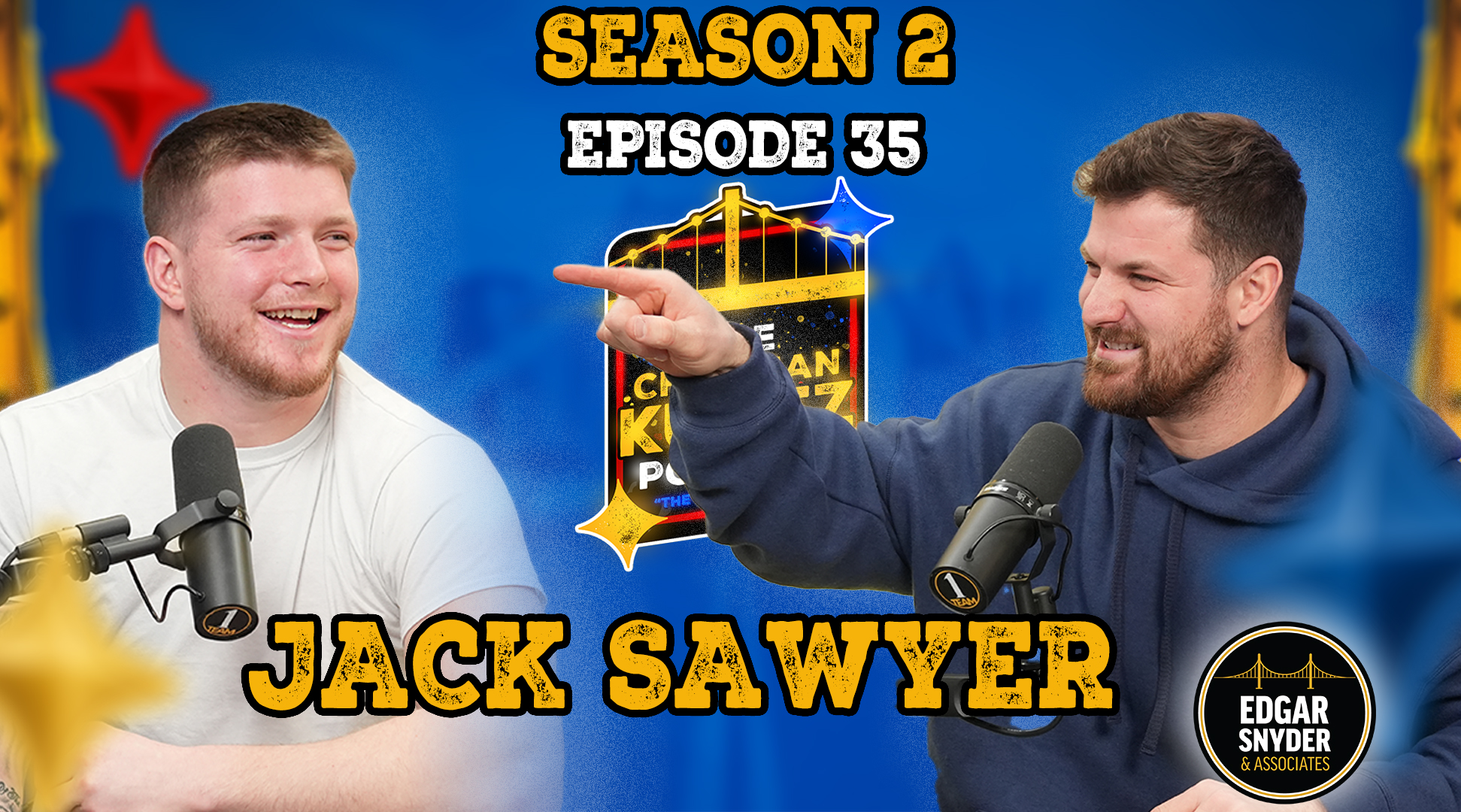

If you have ever wondered what NFL life actually feels like. Not the highlight reels. Not the hot takes. Just the real pace, the real pressure, and the little moments that never make it on TV. This episode of The Christian Kuntz Podcast delivers it.
Christian Kuntz is back in the studio with the usual crew, and he is joined by Steelers rookie edge rusher Jack Sawyer for another laid back, hilarious, and surprisingly insightful conversation that moves from “boys being boys” to the kind of details only players notice.
It starts exactly how you would expect. Jack is back in Pittsburgh, without a car, and Christian has to scoop him like a professional chauffeur. The “pickup package” includes a clean car, black coffee, and Zyn to close the deal. That turns into an all time detour when Christian casually drops that he literally used to drive for a luxury car service between teams, picking up everyone from business people to former players to politicians. The crew jokes about the grind, but the point is clear. Even guys who end up wearing the shield have chapters in their story where they are just trying to keep life moving.
From there, the episode shifts into the reality of long travel, late nights, and how much the body pays for it. Jack and Christian talk about flying home immediately after games and what it is like getting back at 4 or 5 am after West Coast trips. Jack brings up the idea of NFL games overseas and how that kind of travel can mess up your system for weeks. It is the kind of conversation that reminds you football is not just physical on Sundays. It is physical every day.
Jack Sawyer on his rookie season. Honest grades and the rookie wall
When Christian asks Jack to assess his rookie year, Jack is brutally honest. He calls the season fun and says he loved getting into the flow of game planning and competing every week, especially making the playoffs and feeling that atmosphere. But he also gives himself a real grade, around a B minus to C plus, and explains why.
He describes hitting a rookie wall almost immediately in camp. Not because of the games. Because of special teams reps. He talks about taking every rep, learning new demands, and waking up on day four feeling like he cannot move. As the year goes on, he says he started getting more comfortable and trusting himself, and he even jokes about interceptions that basically fell into his arms, along with the one he should have returned but did not.
That theme of self evaluation keeps coming up. Christian explains how, in the NFL, you remember every bad rep forever. The mistakes stay in your brain like they are bookmarked. Jack agrees and says that is just how high level competitors are wired. A hundred good plays can get erased in your head by one wrong step.
The Pro Bowl debate. Why it feels broken
The funniest rant in the episode might be the Pro Bowl conversation. Both guys admit the truth. If you are in it, you celebrate it. If you are not, it is easy to call it dumb.
But their criticism is not just bitterness. They talk about how the standards feel inconsistent. How can someone be first team All Pro and not make the Pro Bowl. Why do some guys get in while others with elite numbers do not. Christian explains that players do get voting paperwork, but the way things shake out makes them question how much the process reflects what players actually think.
They also talk about the NFL as entertainment and how the league is always trying to keep attention, keep numbers, and keep the product moving. Whether you agree or not, it is a real window into how players think about awards versus real performance.
Quarterbacks. Patience, development, and the chess match at the line
The second half becomes a masterclass in how players view quarterback development.
They talk about how unrealistic it is that fans expect every top pick to become elite immediately. Jack and Christian bring up how much context matters. System fit. Coaching. The relationship with the offensive coordinator. Whether the playbook mirrors what the quarterback did in college. They also talk about the older model where quarterbacks sat longer and learned, and how that patience can pay off.
Then Christian pulls the conversation into the details that separate college football from the NFL.
Jack explains that in college you can get free runs at the quarterback because protections are simpler and offenses are more likely to run what is called. In the NFL, protections are more advanced, quarterbacks make adjustments at the line, and elite defenders get chipped, slid to, and schemed against constantly. Jack describes what it is like spelling a star rusher like TJ Watt and immediately getting attention because offenses are protecting for TJ first. The lesson is simple. At this level, there are no easy snaps.
They also go into the film study side. Watching tackle stances. Shotgun back depth. Situational tendencies. Jack says learning trends is huge because everyone is talented, so small tells can become game changing advantages.
Cadence, instincts, and being a “cowboy” the right way
One of the best segments is about instincts.
Christian asks how often guys override the call based on what they see. Jack explains the balance. You cannot freelance all game or you will hurt the defense. But sometimes you do need to be a “cowboy.” If you see something clearly and you can make a play without compromising everyone else, you take it. They talk about how the best players earn that freedom because they know the defense so well they are no longer thinking. They are just reacting.
Jack shares a story about learning cadence tells and how a veteran tip can change everything. He describes the difference between guessing and knowing. As a rookie, one offsides can cost you reps for weeks. So when you time it right, it is a huge win.
What Aaron Rodgers taught Jack. The quarterback view of coverage
This might be the biggest takeaway from the entire episode.
Jack talks about asking Aaron Rodgers questions and learning how quarterbacks process coverage. Rodgers tells him that if defenders drop a certain way, he knows the coverage immediately and often knows where the ball is going as soon as he catches it. Jack even tells a story about Rodgers staring him down while smiling in practice and still throwing elsewhere, basically proving that “reading the QB’s eyes” is not the cheat code young defenders think it is.
That section alone is worth the listen if you care about football at a deeper level. It is the kind of insight you do not get in typical interviews.
The Tony Romo golf story. A reminder that the league is still full of people
Before the episode ends, Christian tells an incredible story. Tony Romo is calling a Steelers game, sees Christian messing around with a golf swing, and casually asks if he wants to play. Christian texts him an invite for his brother and friends. Romo actually shows up and plays with them in late fall. Pays his bets immediately. Makes their day. Then tells them to call him if they are ever in Dallas.
It is one of those moments that captures the whole vibe of the show. NFL legends are still human. And for fans, a random moment like that becomes a lifelong story.
Final thoughts
This episode is funny, but it is not fluff. It is a real look at the grind, the mindset, and the detail that separates the NFL from everything else.
Jack Sawyer comes across as exactly what you want a young pro to be. Honest about his flaws. Hungry to improve. Grateful for the opportunity. And clearly learning from the veterans around him.
And Christian does what he does best. He keeps it loose while pulling out the kinds of stories and questions that only come from someone who lives inside the league.